For the first two seasons, I was killing my seedlings with complete conviction that I was saving them. I watered what I thought was "regularly" — every morning, because that's how you do it, right? The result: yellowing leaves, dropping seedlings, and that characteristic black rot at the root collar, which I later learned is called damping-off. Sounds elegant. Looks horrible.
My neighbor from across the plot — she's been growing seedlings for over twenty years and always has seedlings like from a catalog — asked me once how many times a day I water. When I replied once, but thoroughly, she looked at me with that expression I know from my wife. The kind that says: "Well yes, I understand. Go on."
This article is a record of what I learned from her — and what my own mistakes taught me.
Overwatering — the most common seedling killer
Seedlings die from dehydration less often than we think. Much more often they die from excess water — and in a way that for a long time looks like... insufficient watering. Yellowing leaves? "It must need more water." Dropping stems? "Definitely too dry." And the pouring continues.
The problem lies in what happens underground. Overly moist substrate displaces oxygen from soil pores. Roots — which also breathe — start to suffocate. The weakened plant becomes easy prey for fungi, including Pythium and Fusarium, responsible for the aforementioned damping-off. The effect is irreversible: once attacked, a seedling, especially in the cotyledon stage, practically has no chance.
Neighbor's protip: "If you don't know whether to water — don't water. Seedlings forgive slight dehydration more than excess water."
How to recognize you've overdone the watering:
- The substrate is wet several days after watering
- The stem at soil level becomes dark, soft, wilts
- Leaves yellow from the bottom, even though the soil is still moist
- White coating or mold appears on the substrate surface
Bottom watering method — how it works
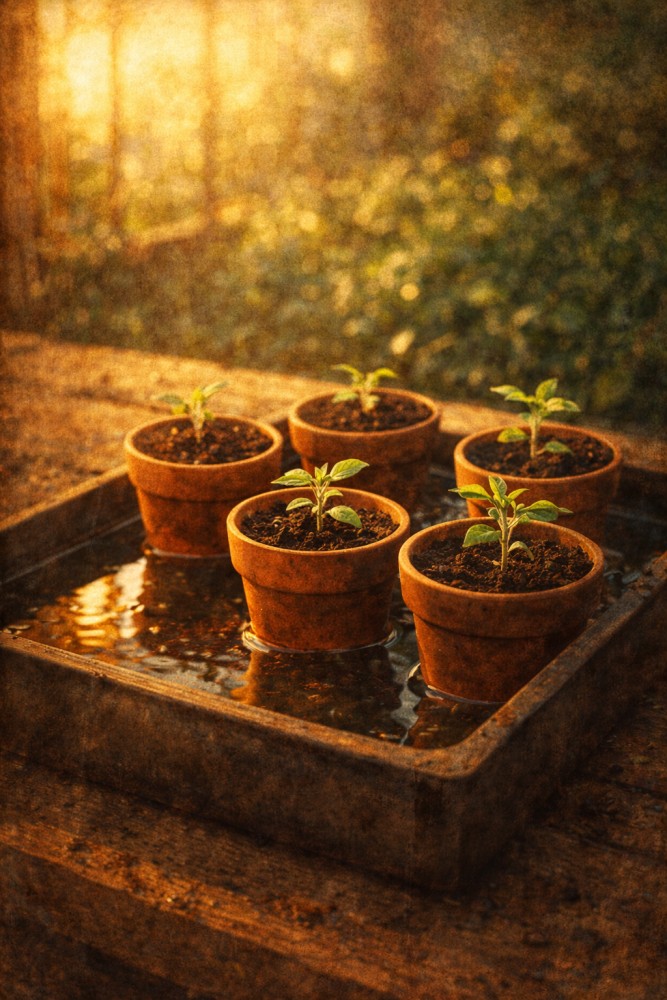
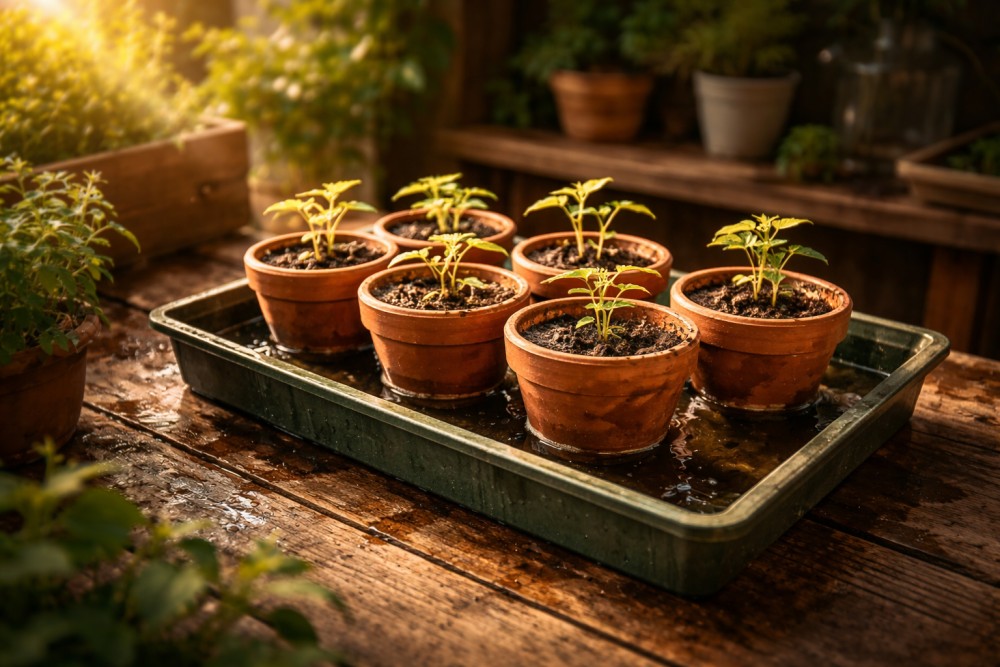
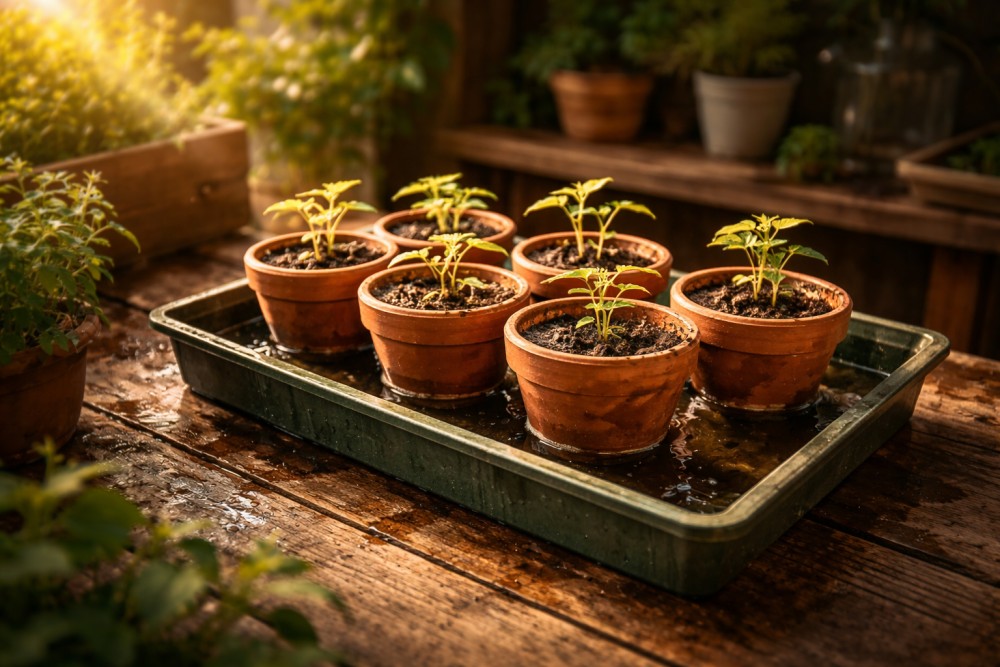
When my neighbor showed me her "system," I thought she was joking for a moment. She placed the pots in a tray of water. That's it. But as soon as I saw the results — I stopped top watering seedlings for good.
Bottom watering means water gets into the substrate through the drainage in the bottom of the pot, not through the surface. The substrate absorbs water capillarily — as much as it needs, no more.
How to do it step by step
- Place pots or seed tray in a container with water (tray, bowl, container)
- Water should reach about 1–2 cm — don't flood the bottom of the pot to the brim
- Wait 15–30 minutes — the substrate will absorb as much water as it needs
- Remove the pots and let them drain for a few minutes
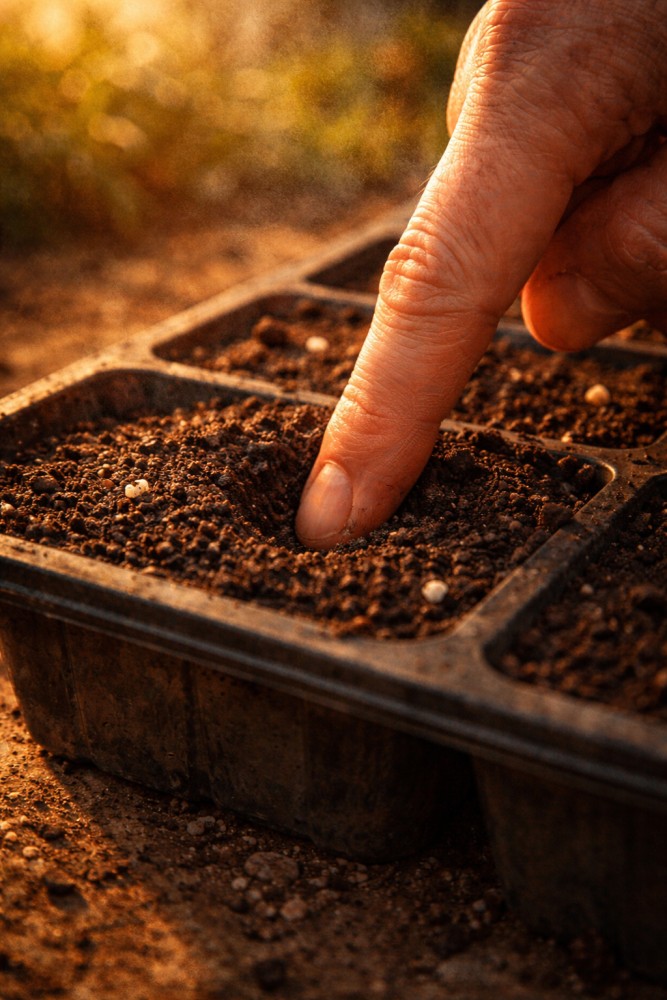
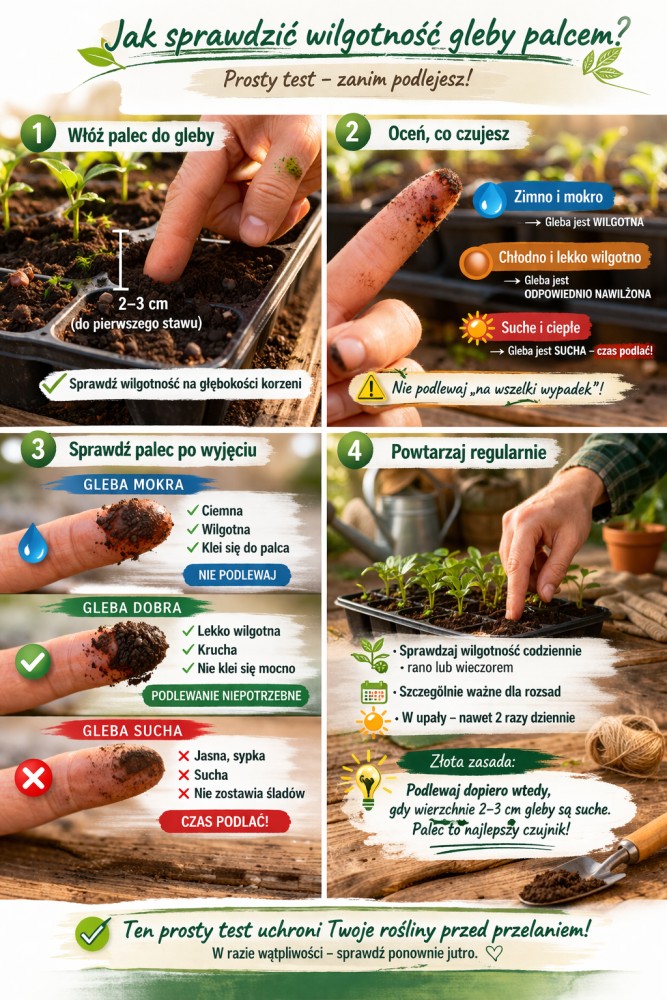
- Check the top layer with your finger — it should still be slightly dry or barely moist
Why this works better than top watering
- Roots grow downward — they follow the water, so the root system develops well
- The substrate surface remains dry — which limits the risk of mold and fungus gnats
- No washing out of seedlings — a water stream from above can knock over delicate seedlings or expose roots
- Even hydration — the entire substrate moistens evenly, not just around the water stream
⚠️ Warning: don't leave pots in water for several hours. 15–30 minutes is usually enough. Too long soaking is also excessive hydration.
How to check if seedlings really need water
Before you reach for the watering can, check. Always. It takes 3 seconds and saves seedlings.
Finger method
Insert your index finger into the substrate about 2 cm deep. If you feel moisture — wait. If the substrate is dry at this depth — time to water.
Stick method
Stick a wooden stick (like a skewer) into the substrate. Pull it out after 10 seconds. If there are traces of moist soil on it or the stick is dark — not yet needed. If it comes out dry and clean — water.
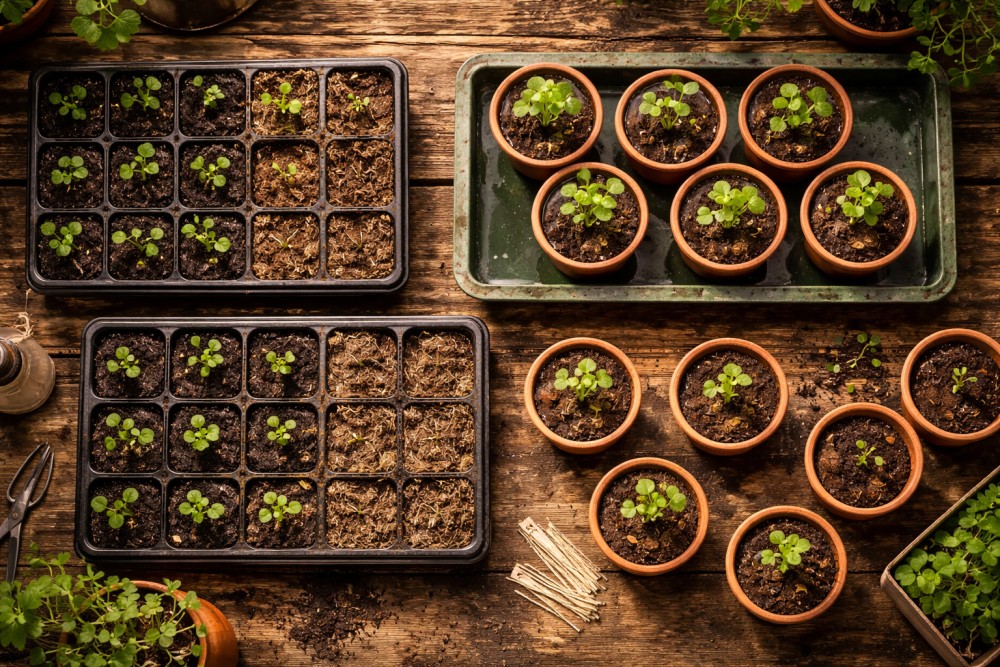
The stick method works particularly well in multi-cell seed trays where your finger doesn't always fit properly.
Water temperature — a detail that matters
I didn't know this for a long time. I watered straight from the tap — with cold water, because "water is water," right? But cold water causes something like thermal shock in seedlings: it slows nutrient uptake, can cause leaf yellowing, and with sensitive species (pepper, basil) — visible plant stress.
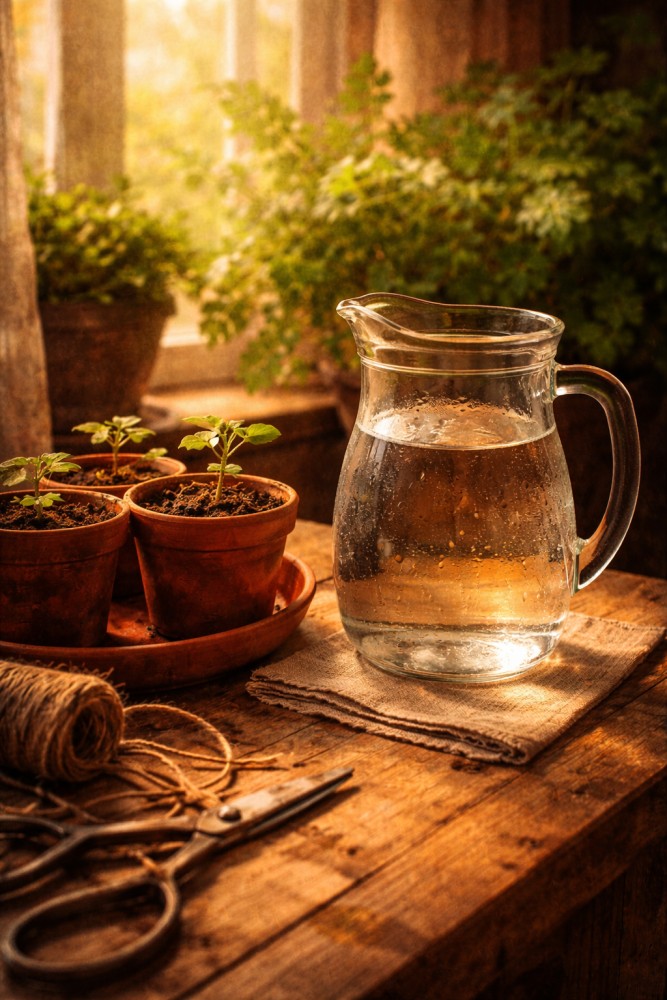
The rule is simple: water for watering seedlings should be at room temperature. Practically, this means one thing: collect water in the evening and leave it overnight. In the morning you have water at the right temperature, dechlorinated for several hours — ready to use.
What else is worth knowing about water:
- Soft water (rainwater, filtered) is better than hard tap water — lower risk of substrate calcification
- Don't water with ice-cold water straight from outside or from a cold basement
- With seedlings in a growbox, the ambient temperature is higher — water warms up faster, but it's still worth starting with room temperature
Germinating seeds vs. seedlings with leaves — different approaches
This isn't one type of plant that you handle the same way. A seedling in the germination stage and seedlings with several pairs of true leaves are two completely different cases.
| Stage | Watering method | Frequency | Notes |
|---|---|---|---|
| Seeds in germination phase | Mist / spray bottle from above | Several times daily (surface cannot dry out) | No roots = no absorption from below |
| Seedlings after emergence (cotyledons) | Mist or very carefully from below | Every 1–2 days, checking moisture | Delicate roots, sensitive to washing out |
| Seedlings with 1–2 pairs of true leaves | From below | Every 2–4 days, using finger/stick method | Roots developed, water well absorbed |
| Seedlings ready for transplanting | From below or carefully from above | Every 2–3 days | Larger substrate volume = slower drying |
Important: In the germination phase, the substrate must be constantly slightly moist — but not wet. A glass cover, film, or tray lid helps maintain moisture without constant watering.
Growbox — specifics of enclosed space
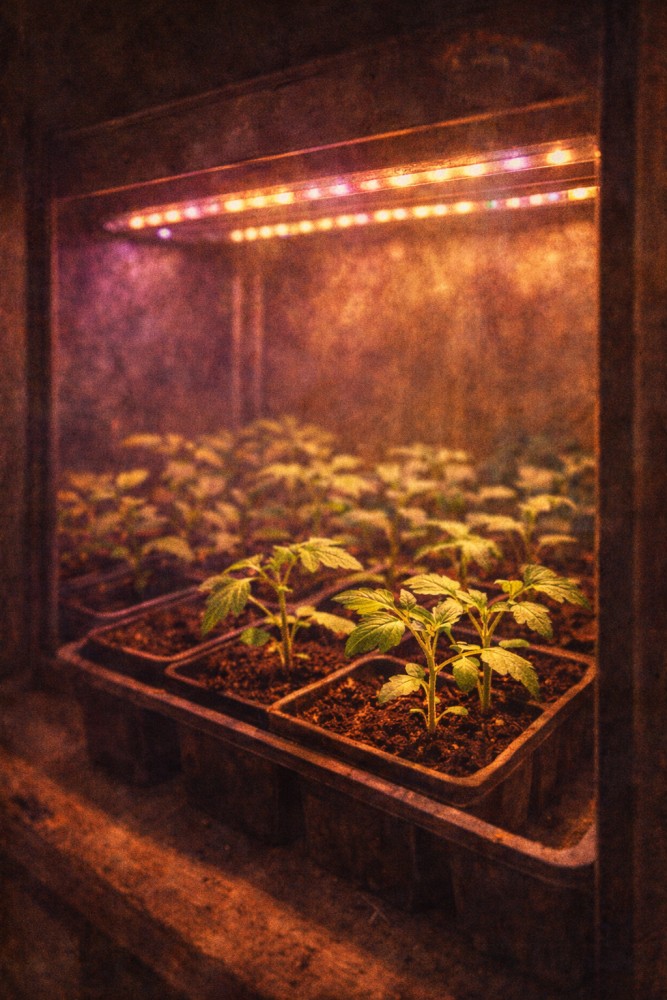
If you're growing seedlings in a growbox (enclosed cabinet with LED lighting and ventilation), the rules change a bit.
Why a growbox is a special case
- No natural atmospheric transpiration — air in enclosed space saturates with moisture faster; substrate dries slower than on a windowsill
- Constant temperature — no daily fluctuations, which slows water consumption by the plant
- No wind — natural "pulling" of air through the plant is limited, transpiration lower
- LEDs generate less heat than HPS — substrate doesn't dry from above as quickly as with older lamps
Practical rules for growboxes
- Water less frequently than on a windowsill — check with finger method before each watering
- Leave doors ajar for 30–60 minutes after watering to remove excess moisture from the air
- Ventilation must work — humid air without movement creates ideal conditions for mold
- If using a tent, monitor air humidity — target 50–65% RH for seedlings
In the growbox, I discovered that my tomatoes needed water every 3–4 days, not daily like on the windowsill. Different microclimate, different rules.
Checklist — watering seedlings without mistakes
- Before reaching for water — check the substrate with finger or stick
- Use room temperature water (collect in the evening, leave overnight)
- Germinating seedlings = spray bottle; seedlings with leaves = bottom method
- Don't leave pots in water longer than 20–30 minutes
- After watering, let pots drain — they shouldn't stand in puddles
- In growbox, check substrate more often than you think you should — but water less frequently
- Yellowing leaves with wet substrate = alarm signal (overwatering, not deficiency)
If you're growing seedlings and want to know when to water them — in the Zielna Manufaktura app you can set push notifications with watering reminders, tailored to specific species. Without looking at the calendar. The web version already works at zielnamanufaktura.pl, and the Android app is in beta phase.