A few days ago, I published a comprehensive tomato guide on this blog — from seedlings to the first ripe fruit. I received several questions in the comments and privately, which all revolved around one topic: pruning. "Should I prune at all?", "When to prune?", "Won't it harm the plant?". So I decided to do a follow-up.
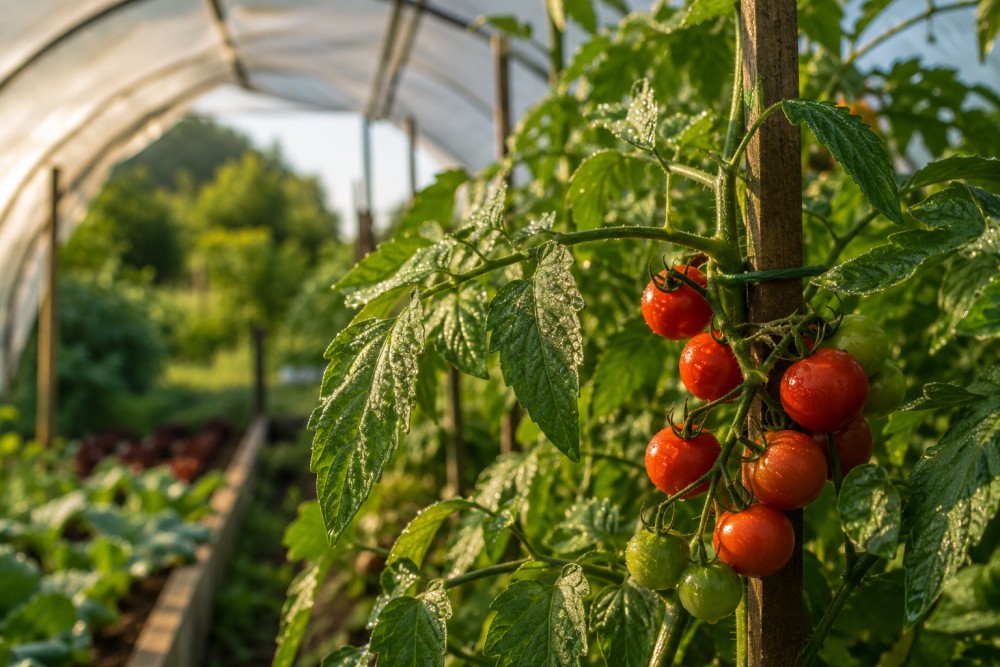
Three years ago, in my first season in Bieszczady, I made every single mistake with tomatoes that I'm about to describe. All of them, one by one. Magda looked at the plastic tunnel where my cherry tomatoes were growing and said something that I still translate to myself as "creative interpretation of gardening principles". Cirí sat on the windowsill and — as Magda claims — looked with pity. Hard to blame her: as Head of QA, she had the right to be disappointed.
Tomatoes are a plant that I, as a programmer, only understood when I started thinking about them like a system with branches. Each side shoot is a new branch in the tree — either it clutters your daily logic, or it produces fruit. You need to decide consciously. And consciously doesn't mean chaotically with scissors in hand.
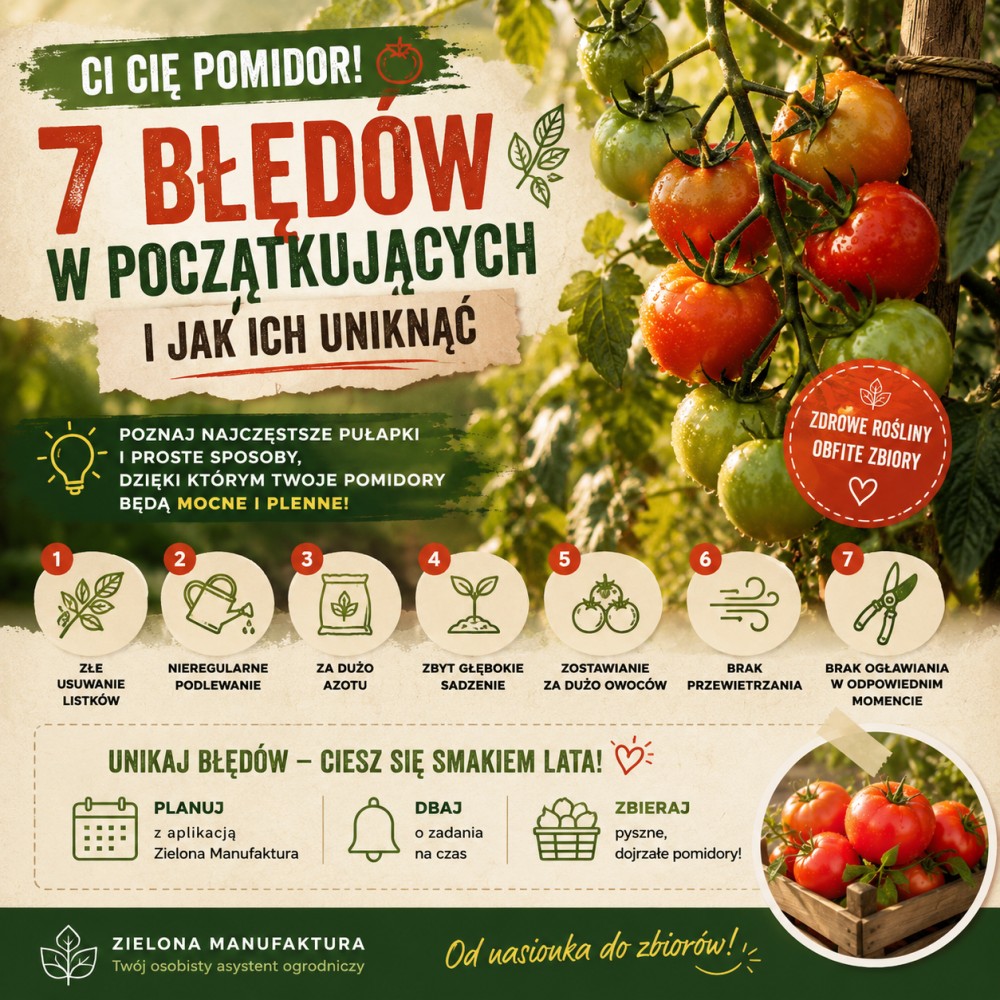
Here are 7 mistakes I made myself — and how to fix them.
1. Cutting leaves instead of side shoots
This is the mistake. A classic. You stand by the plant, see that it's dense, and instinctively cut what catches your eye most — large leaves. Meanwhile, 90% of the density problem is side shoots, not leaves.
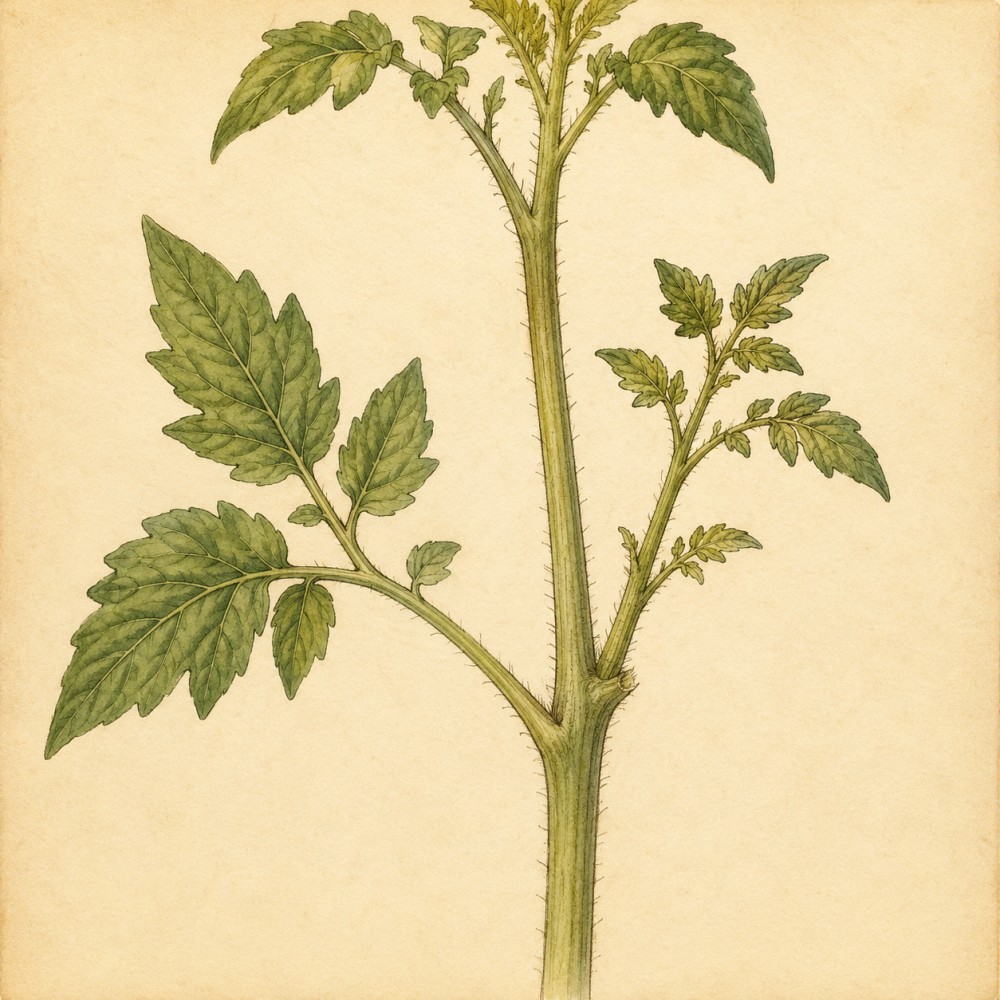
How to recognize: A side shoot (also called sucker or side shoot) grows in the angle between the main stem and a leaf. It looks like a miniature, young branch with its own little leaves, hidden in the leaf axil. A leaf grows directly from the stem, has one stalk and leaflets — never branches right from the emergence point.
How to fix: Look in the leaf axils. Always. When you see something there that looks like a miniature clone of the main stem — that's a side shoot and that's what needs to be removed. Leave the leaf itself (even a large one) unless it yellows or blocks light from a flower cluster.
2. Cutting with scissors instead of fingers
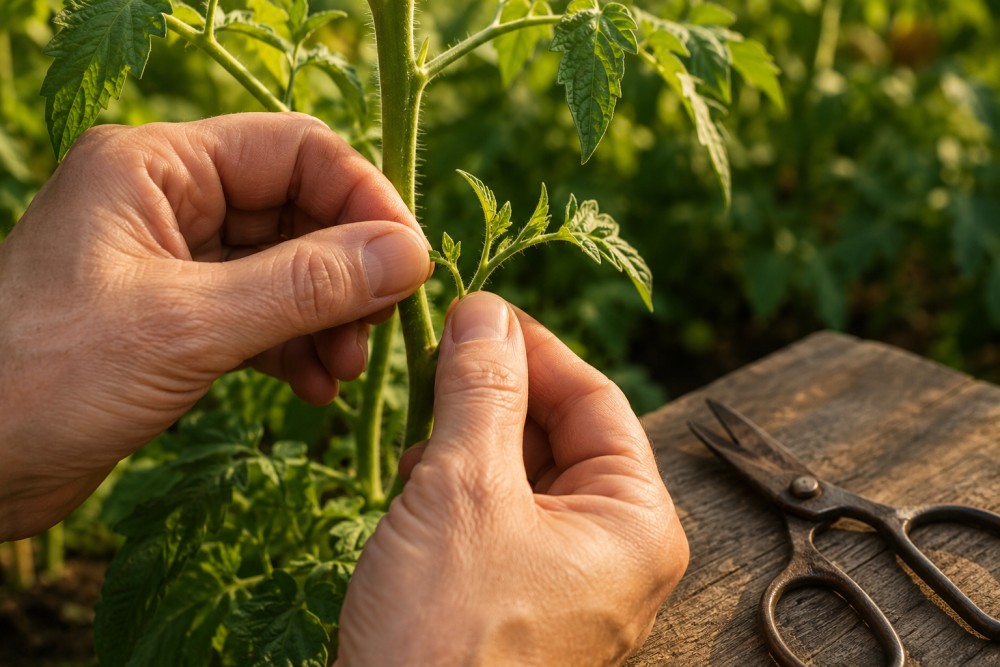
My first season I carried a fancy pruner with me. It looked professional. Then a neighbor friend saw me with the tomatoes and despaired. "Give yourself a break, you have fingers — use your fingers."
How to recognize: You look at the cut wound a few days later. After pruners, it often looks like a clean surgical cut that heals slowly. After breaking with fingers — the break follows the plant's natural line and heals faster, because the plant immediately "knows" that this piece was meant to fall off.
How to fix: Break off small side shoots (up to 3–5 cm) with your thumb and index finger — sideways and slightly downward. Only reach for scissors with older, woody side shoots. And then — necessarily disinfected (alcohol, denatured alcohol) between each plant. Otherwise, you're transferring diseases from one plant to another. This also applies to borrowed scissors from neighbors — even if their plants look healthy.
3. Cutting on a rainy day
Magda calls this "Marek thought he was a stoic". Because rain doesn't deter me and once I insisted on finishing pruning during drizzle. A week later I had tomato blight (Phytophthora) on three plants.
How to recognize: Fresh wound + moisture + fungal spores circulating in the air = open door for pathogens. Phytophthora, Botrytis (gray mold), Alternaria — they all love wet, freshly opened wounds.
How to fix: Cut only in dry weather and on dry plants. I aim for morning hours the day after a sunny day, when the morning dew has already dried. If the forecast predicts rain within the next 24h — I postpone until the next weather window. Weather alerts (before rain, storms, sudden temperature drops) were one of the first features I built into Zielna Manufaktura because I needed it most myself.
4. Cutting in full sun
The other side of the "dry weather" coin: too much of a good thing. In July, at noon, in 32°C in a Bieszczady tunnel — this is not the time to traumatize plants.
How to recognize: Cut plants in heat wilt even if they have plenty of water. For 2–3 hours after cutting, they behave like someone who just left the dentist's office after having a molar pulled — in theory "all done", in practice they haven't recovered yet.
How to fix: Cut in the morning (after dew dries, before the sun gets high) or late afternoon when the sun is setting. In Bieszczady, I have a window roughly 8:30–10:30 and another after 17:00. The plant then has time to heal and doesn't lose water excessively from the open wound.
5. Leaving too many flower clusters
Classic expectation trap: "The more clusters, the more tomatoes, right?". No. The more clusters, the more small tomatoes that won't have time to properly fill out. Especially in our climate, where the season doesn't stretch into October.
How to recognize: You look at the plant at the end of July and see 8–9 clusters on one stem. Or (worse) — the first clusters are small, fruits underdeveloped, and the plant keeps producing new flowers.
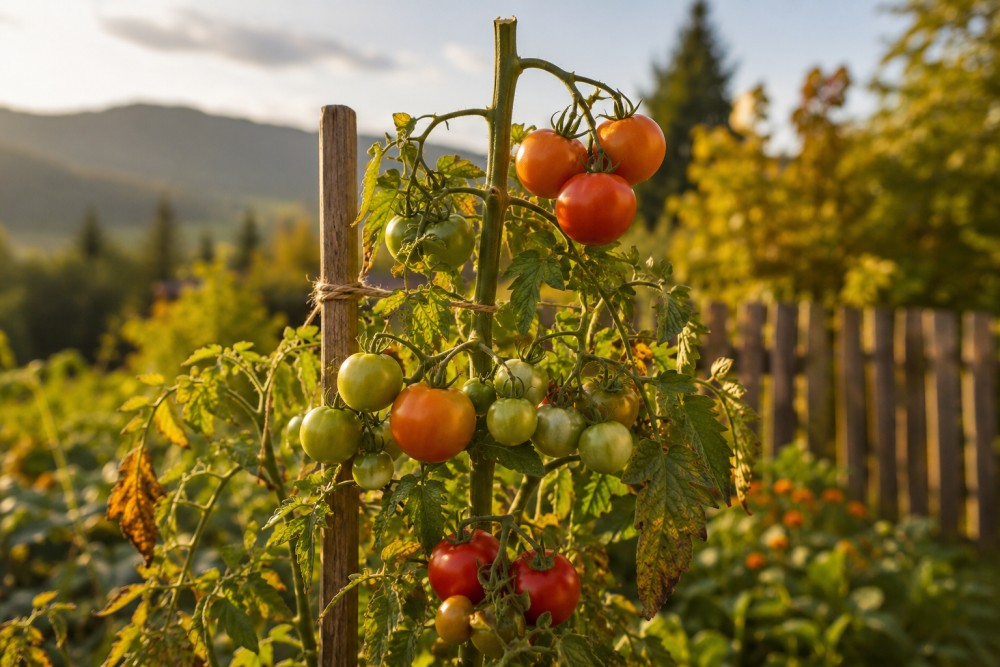
How to fix: For tall varieties (indeterminate) leave 5–6 clusters in ground varieties and 7–8 in tunnel/greenhouse. Remove the rest of excess flower clusters already at the bud stage. For short varieties (determinate) — don't touch the clusters, these are programmed to be self-limiting and will stop on their own. If you don't know whether your variety is indeterminate or determinate — check the description on the seed package or in the plant database.
6. Not indicating the main stem
For tall varieties, the key question is: which way does the trunk go? Without a clear answer, the plant does what all systems without specifications do — chaos.
How to recognize: You look at the tomato and see a "bush" instead of a column. Three or four stems in parallel, each starting its own life, none going clearly upward. Number of clusters divided equally among each = all poor.
How to fix: Choose one leading stem — the one that goes up strongest and from which clusters have grown so far. Tie it to a stake or string. Treat the remaining stems like side shoots and remove them. Some people leave two leaders — you can, but then choose consciously, don't leave "everything that grew".
7. Not topping at the end of the season
The last mistake — and probably 80% of beginners make this one. The season enters August, the tomato is two meters tall, flowering at the top, you're happy it's growing so well. Meanwhile, those new flowers in August in central Poland (and especially in Bieszczady) won't have time to set and ripen. The plant is wasting energy.
How to recognize: Mid-August, tomato still flowering at the top, bottom clusters green, middle ones barely reddening, and you catch yourself thinking "this year it'll be September before they're ready".
How to fix: Top it. That is, cut off the top of the main stem above the last cluster you consider capable of ripening. In Bieszczady I do this around August 5–10. In central Poland you can push it to August 15–20. After topping, the plant redirects all energy to already set fruits, not to new, hopeless flowers. This is one of those treatments where you can see the final effect fastest — fruits ripen noticeably faster and fill out thicker.
What's next
That's it. Seven mistakes I tested myself on my own piece of land (Cirí confirms — as Head of QA, that's with authority; official position: "meow"). If something still doesn't fit or you have a question I didn't address here — leave a comment, I'll reply. Or write to kontakt@zielnamanufaktura.pl.
If you missed it — here's the previous article about tomatoes (from seedlings to first fruit). Together they form a whole: how to bring a tomato to fruit and how not to ruin it with pruning afterward.
About Zielna Manufaktura
I'm making an after-hours app for hobby gardeners in Poland. Inside there is:
- database of ~100 plant species calibrated for Polish climate (vegetables, herbs, flowers, shrubs)
- sowing, planting and harvest calendar adapted to your zone
- garden planner — arrange beds and crop rotation
- light meter in phone (check if windowsill can handle seedlings)
- weather alerts — before frost, downpour, storm
- push notifications about deadlines (watering, fertilizing, harvesting)
- garden diary — so you won't guess next year when you sowed what
- disease and pest scanner from phone photo (in Polish)
- community blog — read and post your own entries
Currently the app is free — it's in beta phase on Android. I'm looking for testers: Google requires 12 people to be simultaneously registered for 14 days straight before I can release the app publicly. If you have Android and want to help — go to zielnamanufaktura.pl/beta. The requirements are simple: install and don't uninstall for 2 weeks. Every founding tester gets Premium for life and their nickname on the /supporters subpage as thanks.
Marek — after-hours programmer, hobby gardener from Bieszczady. Cat Cirí serves as Head of QA (which she performs in a fully feline manner — from the windowsill, with pity).