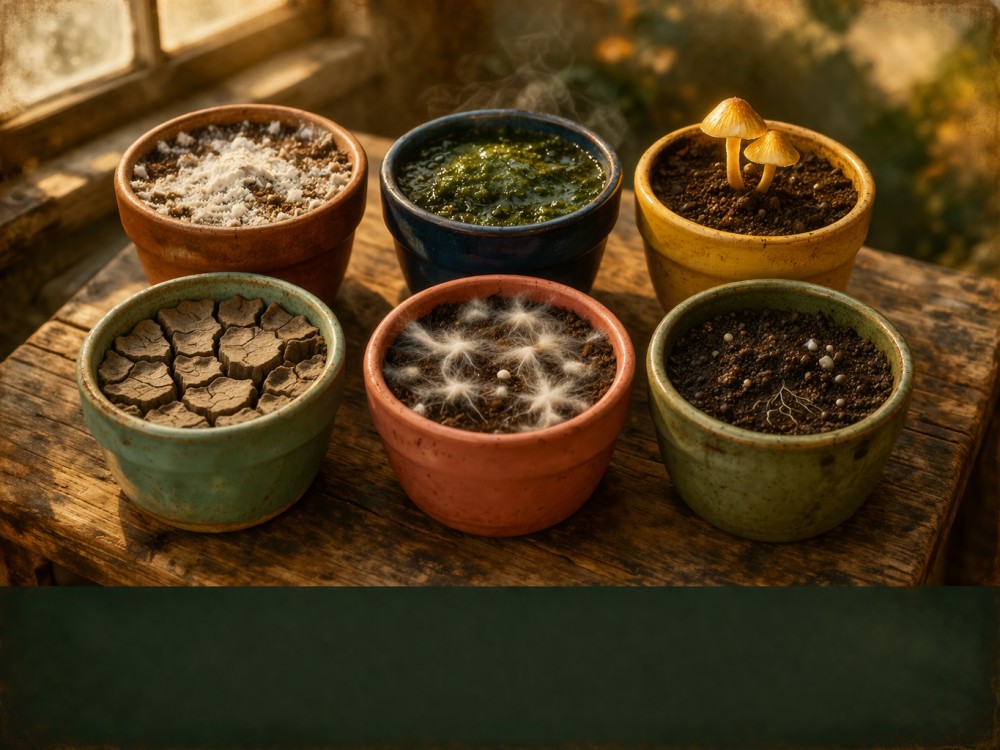
Compost is not silent. It speaks – just not with words. White coating, green layer, fungi, cracks… Each of these signals is information. You just need to know how to read them.
I'll be honest — for the first two years in the garden, I treated the composter like a black box. Throw in scraps, close it, after some time take out brown soil. Or don't take it out, because nothing interesting was created there.
Only when I started looking at what happens on the surface of the compost did I understand that this pile of decomposing matter is constantly trying to tell me something. Like a child who doesn't speak in full sentences yet, but already points to what it needs.
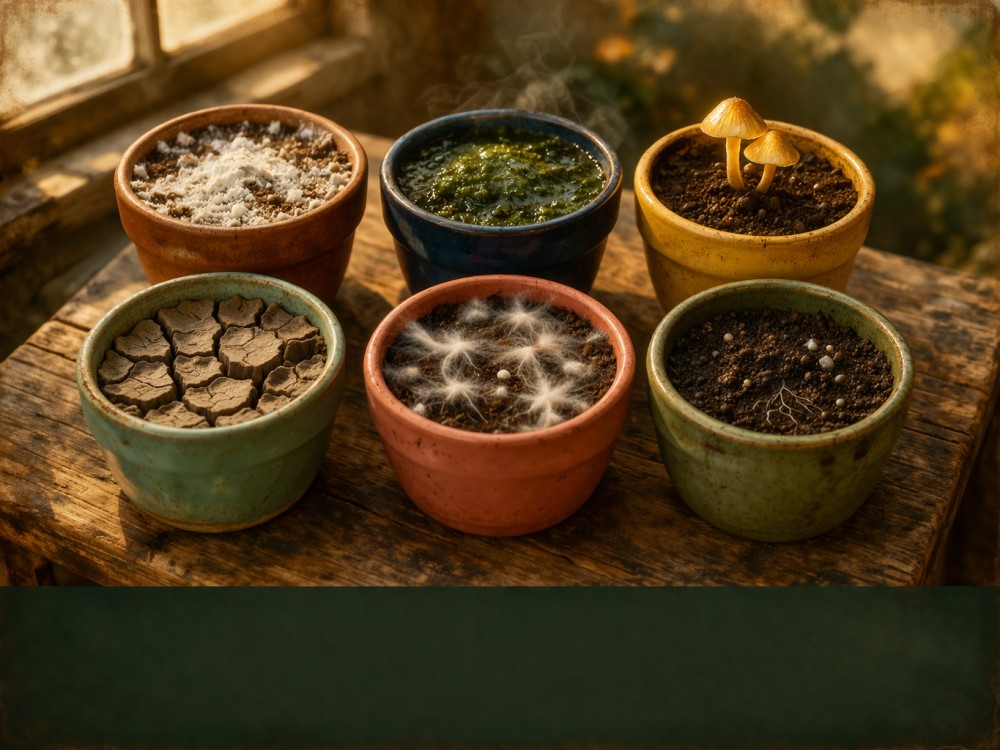
Below are six signals worth recognizing. Each carries specific information and has a specific solution.
1. White coating — excess mineral salts
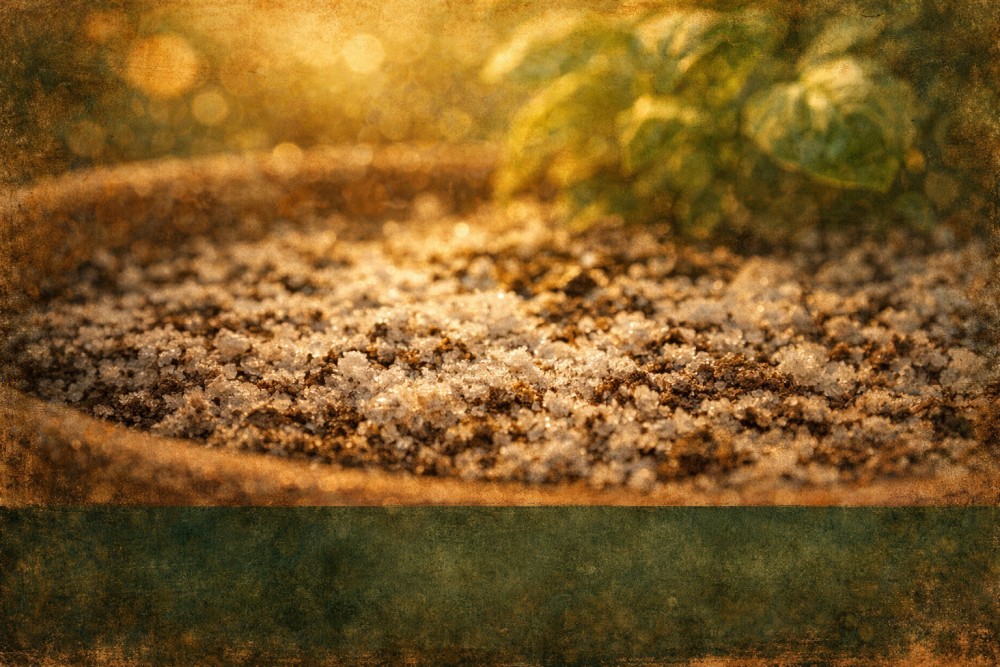
If a white, powdery residue appears on the surface of substrate or compost — it's most likely mineral salt deposits. This happens when water evaporates too quickly, leaving salts on the top layer.
Where do they come from? Most often from mineral fertilizers, poor quality tap water, or repeated watering without flushing the substrate. In pots, it also appears on terracotta walls — that characteristic white stripe that sometimes looks like mold, but isn't.
What to do? Remove the top layer of substrate and discard. Flush the substrate thoroughly with water to wash out excess salts. With the composter, check what we're adding — whether there's too much wood ash or mineral fertilizer.
2. Green layer (algae) — too much moisture
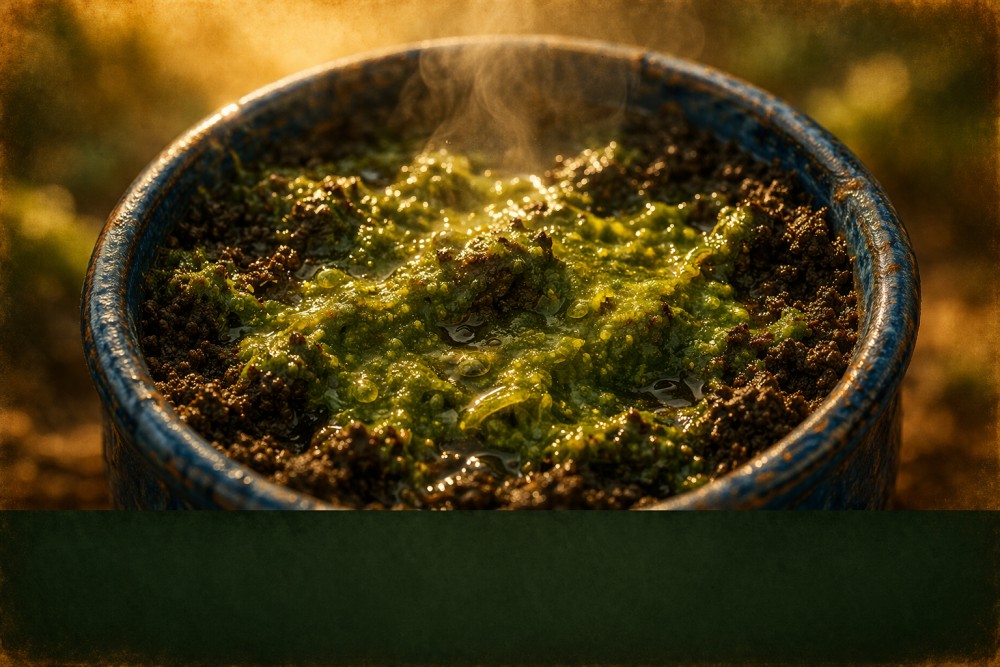
Green, feltlike or slimy coating on the surface of compost or substrate is a signal that moisture is too high and water has nowhere to drain. Algae love stagnant moisture and access to light.
Where most commonly? In balcony boxes without drainage holes, in pots placed in saucers full of water, on top of a composter that's covered too tightly.
What to do? First of all — improve drainage. Check drainage holes, empty saucers. In the composter, mix contents with a fork and add dry material: straw, cardboard, dry leaves. Algae themselves aren't dangerous, but they signal an environment where plants can rot.
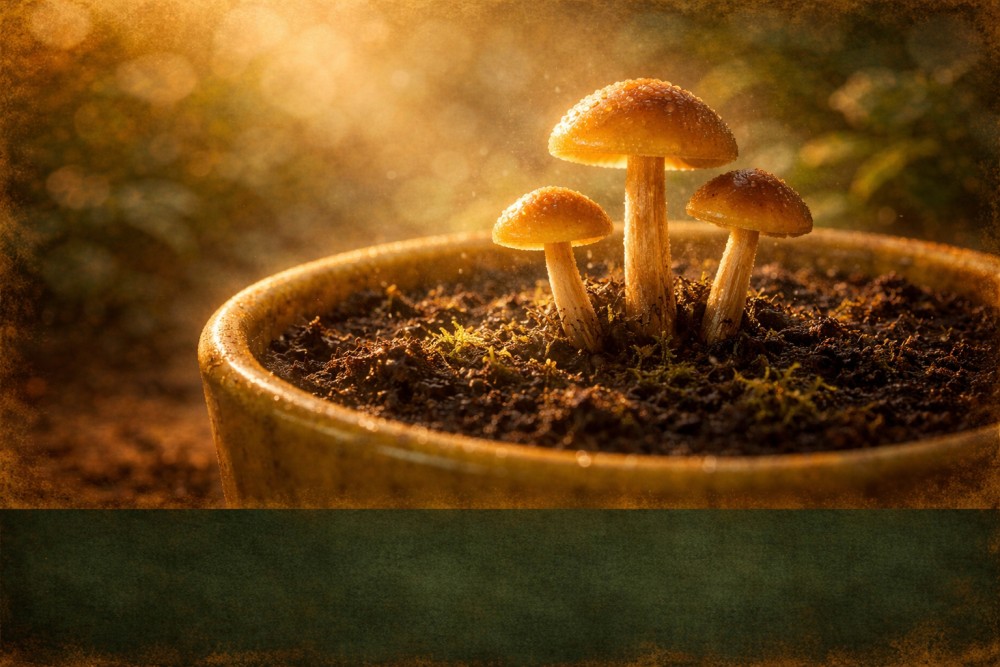
3. Fungi (mycelium or fruiting bodies) — compost is alive!
This is probably the most surprising entry on this list. When I first saw mushrooms growing from my composter, my first thought was "something went wrong". Well, no — this is one of the best signals you can get.
Fungi are decomposers. Their mycelium penetrates organic matter, breaks down lignin and cellulose — things that bacteria handle less well. Active compost with mycelium is compost that's working.
Is this always good? Mushroom fruiting bodies in the composter — absolutely positive signal. Mycelium in pots with plants — here it's worth being more careful, as it may mean substrate that's too moist or too much poorly decomposed organic matter.
What to do? In the composter — nothing. Be happy and observe. In a pot — check moisture and ventilation.
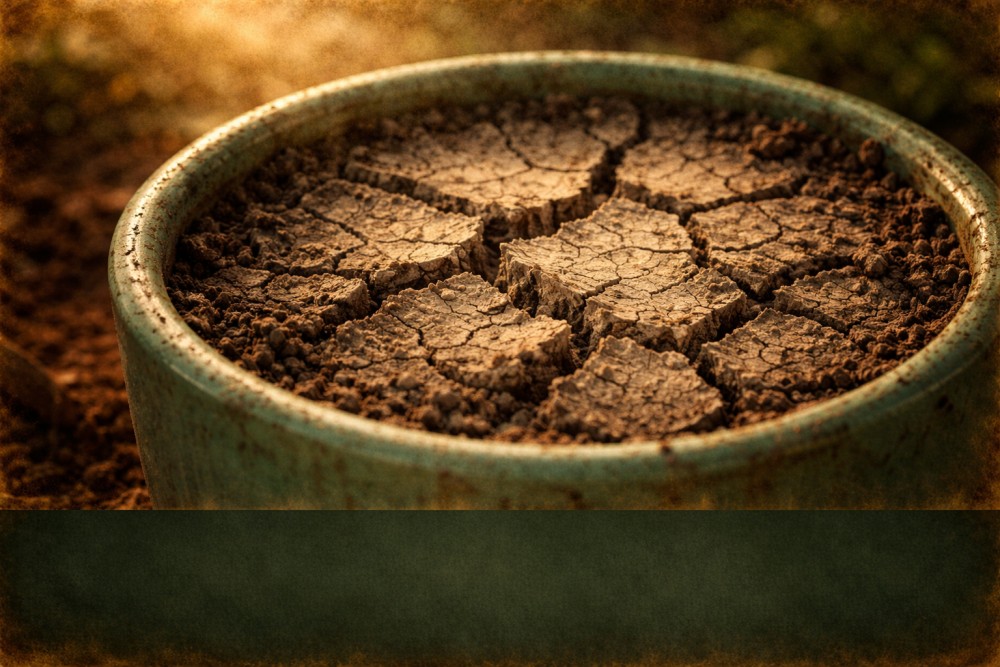
4. Cracked surface — severe drying out
Cracks and fissures on the compost surface are an alarm signal. The substrate is so dry that it has shrunk and pulled away from pot walls or composter sides. This isn't a gentle signal — it's a cry for help.
Why is this a problem? When substrate cracks, water poured from above doesn't soak in evenly — it flows through cracks straight to the bottom, bypassing roots. The plant remains thirsty despite our watering. In the composter, drying out stops the entire decomposition process — microorganisms and earthworms need moisture to live.
What to do? In a pot: submerge it in a bowl of water for 15–20 minutes so the substrate absorbs moisture from below. Top up the surface layer with fresh substrate or mulch.
In the composter: water abundantly and cover with wet burlap or straw. Alternatively, add fresh, wet kitchen scraps.
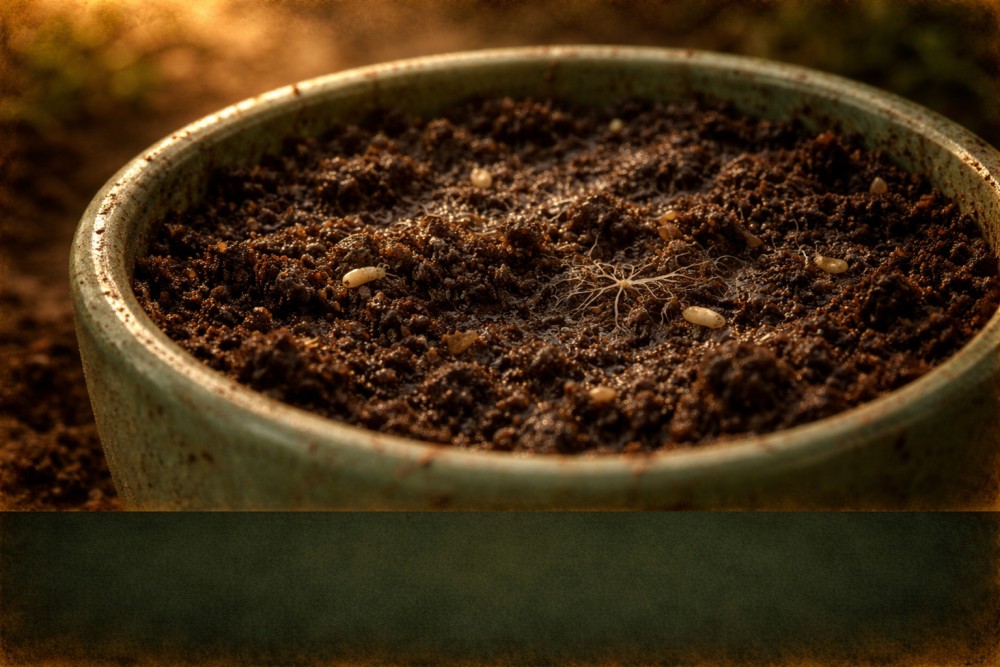
5. Gnats (Sciaridae) — larvae in moist layer
Small, slow gnats flying around pots or the composter, and after digging through the top layer — tiny, white larvae? These are fungus gnats, or Sciaridae. Their larvae feed on decomposing organic matter in moist, upper substrate.
Is this dangerous? Larvae can damage young, delicate roots — seedlings are especially sensitive to this. Mature plants usually tolerate them without major problems. But who likes gnats circling in the kitchen?
What to do? The most effective method is: reduce watering frequency and dry out the top layer of substrate (larvae can't tolerate drought). You can also apply 2–3 cm of quartz sand on top — it blocks the reproduction cycle. In the composter, covering the top layer with dry material helps.
6. White mold — lack of air circulation
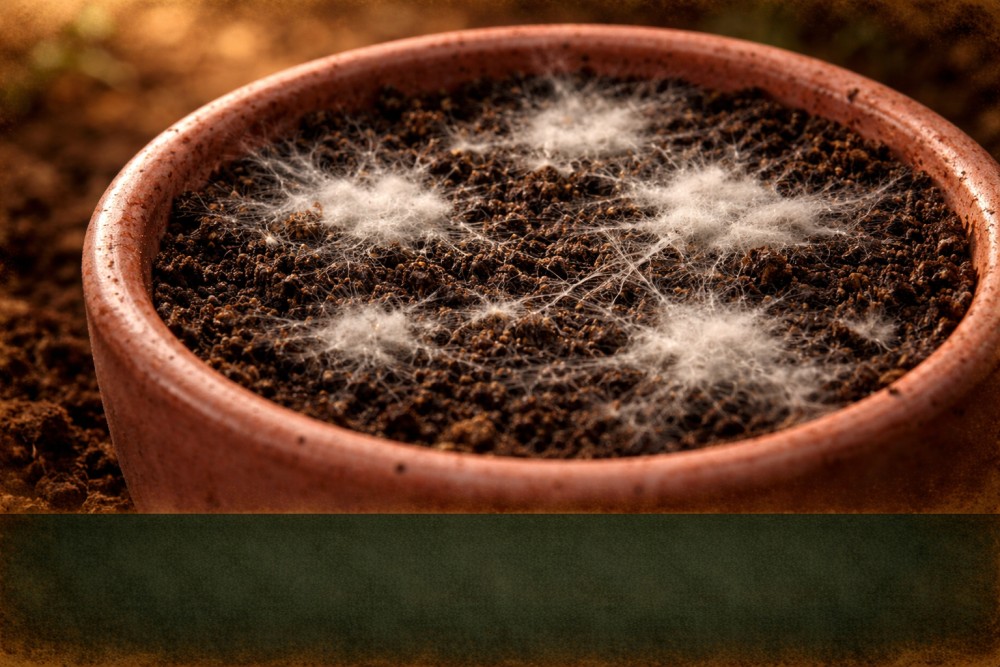
White, cobweb-like coating on the surface of compost or substrate is mold. Unlike white salt coating — this has structure, looks like cotton or spider web.
Is this dangerous? In the composter — no. Mold is also a decomposer. The problem appears in pots with plants: it may mean substrate that's too heavy, lack of air flow, or that we added fresh (uncomposted) organic matter to the pot.
What to do? In the composter: mix and aerate the mass. Add dry structural material (straw, twigs).
In a pot: remove the top layer with mold, check drainage, reduce watering. If the plant seems healthy — it's often just a matter of too sealed environment, not disease.
Summary: quick reference table
Signal -> What it means -> What to do
White coating (powdery) -> Excess mineral salts -> Flush, remove top layer
Green layer (algae) -> Too much moisture, poor drainage -> Aerate, improve drainage
Fungi / mycelium -> Active, healthy compost -> Be happy
Cracks -> Severe drying out -> Water from below, mulch
Gnats and larvae -> Moist layer, decomposing matter -> Dry the surface, quartz sand
White mold (cobweblike) -> Lack of air -> Aerate, improve drainage
White coating (powdery) -> Excess mineral salts -> Flush, remove top layer
Green layer (algae) -> Too much moisture, poor drainage -> Aerate, improve drainage
Fungi / mycelium -> Active, healthy compost -> Be happy
Cracks -> Severe drying out -> Water from below, mulch
Gnats and larvae -> Moist layer, decomposing matter -> Dry the surface, quartz sand
White mold (cobweblike) -> Lack of air -> Aerate, improve drainage
Finally — about the app
As a programmer with gardening ambitions, I'm building an app for Polish hobby gardeners in my spare time. Zielona Manufaktura is a free sowing calendar, plant database, and garden journal. I test everything on my own plot — which sometimes ends better, and sometimes becomes material for another article.
If you want to try it: zielnamanufaktura.pl
Diagnostic photos my own / informational graphics. Have questions or your own observations from the composter? Write in the comments — I'm learning together with you.